Ledgerlight: EVM Block Explorer
A read-only EVM block explorer with Keccak-256 and EIP-55 checksumming implemented from the specifications, a real JSON-RPC client, wallet connection over EIP-1193, and a fixture node so the interface works offline without pretending to be live.
This is a working demonstration, not a client engagement. The brand and data are fictional.
Background
A block explorer is a good test of whether someone understands a chain or merely uses a library for it. This one implements the primitives (the hash function, the address encoding, the RPC protocol) rather than importing ethers or viem.
The challenge
Two things are easy to get wrong and easy to hide. The first is Keccak-256: it is not SHA3-256, the padding differs, and a wrong implementation produces plausible-looking hashes. The second is honesty about data source: a demo with no network access can quietly serve fixtures while claiming to be live.
Objectives
- Implement the primitives (hash function, address encoding, RPC protocol) rather than importing them.
- Stay read-only by construction, with no path that could sign or send.
- Never let a fixture be mistaken for a live chain.
My role
Sole designer and developer
- Implemented Keccak-256 from the permutation, with the original 0x01 padding rather than NIST SHA3's, tested against the published Ethereum vectors
- Implemented EIP-55 checksum encoding and validation, tested against all four vectors in the specification
- Wrote the JSON-RPC 2.0 client with timeouts and typed failures for unreachable, timed out, RPC error, malformed and not-found
- Built a fixture node that implements the same JSON-RPC envelope, including null results and -32601 for unknown methods, so the client code under test is the real one
- Implemented EIP-1193 wallet connection, read-only, with a test asserting it never calls any signing or sending method
- Held every quantity as a bigint, with formatting that truncates rather than rounds
- Wrote 62 unit tests and 25 browser checks
Technical approach
Test the cryptography against published vectors, including an explicit assertion that the output is not SHA3-256. For the data source, build the fixture as a real JSON-RPC node rather than a mock, and make the interface state which source it is using in a banner that cannot be missed.
What is implemented
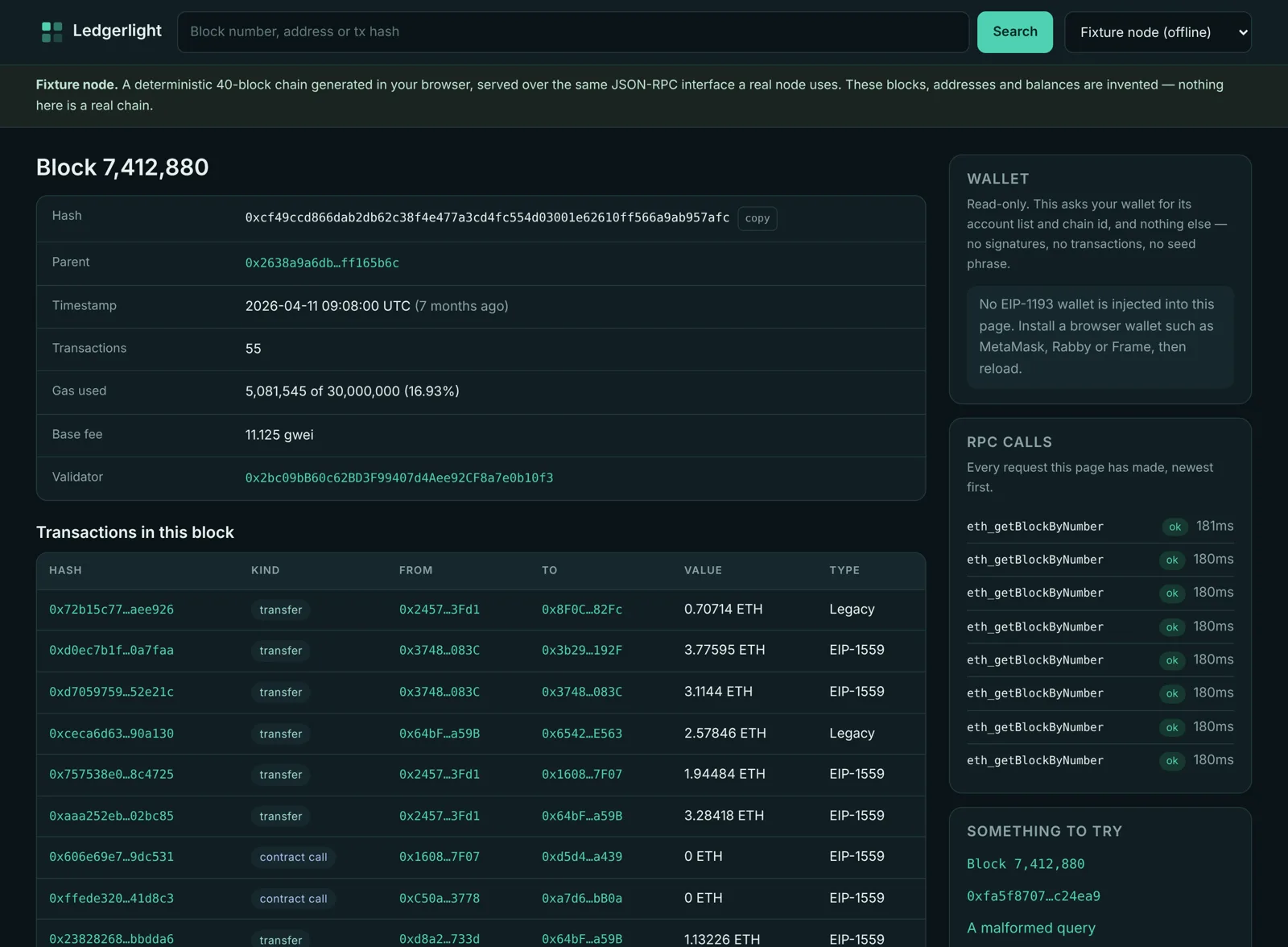
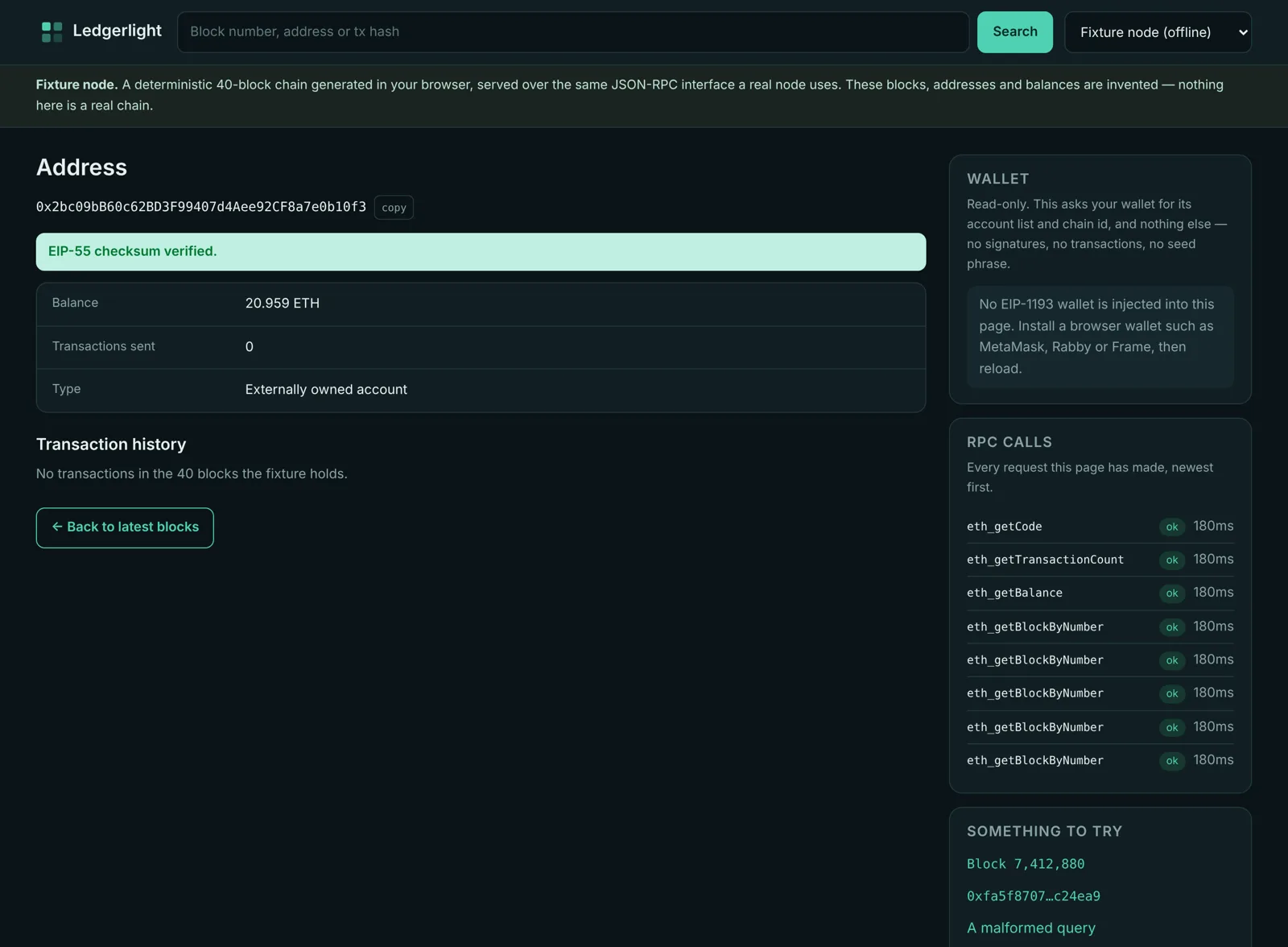
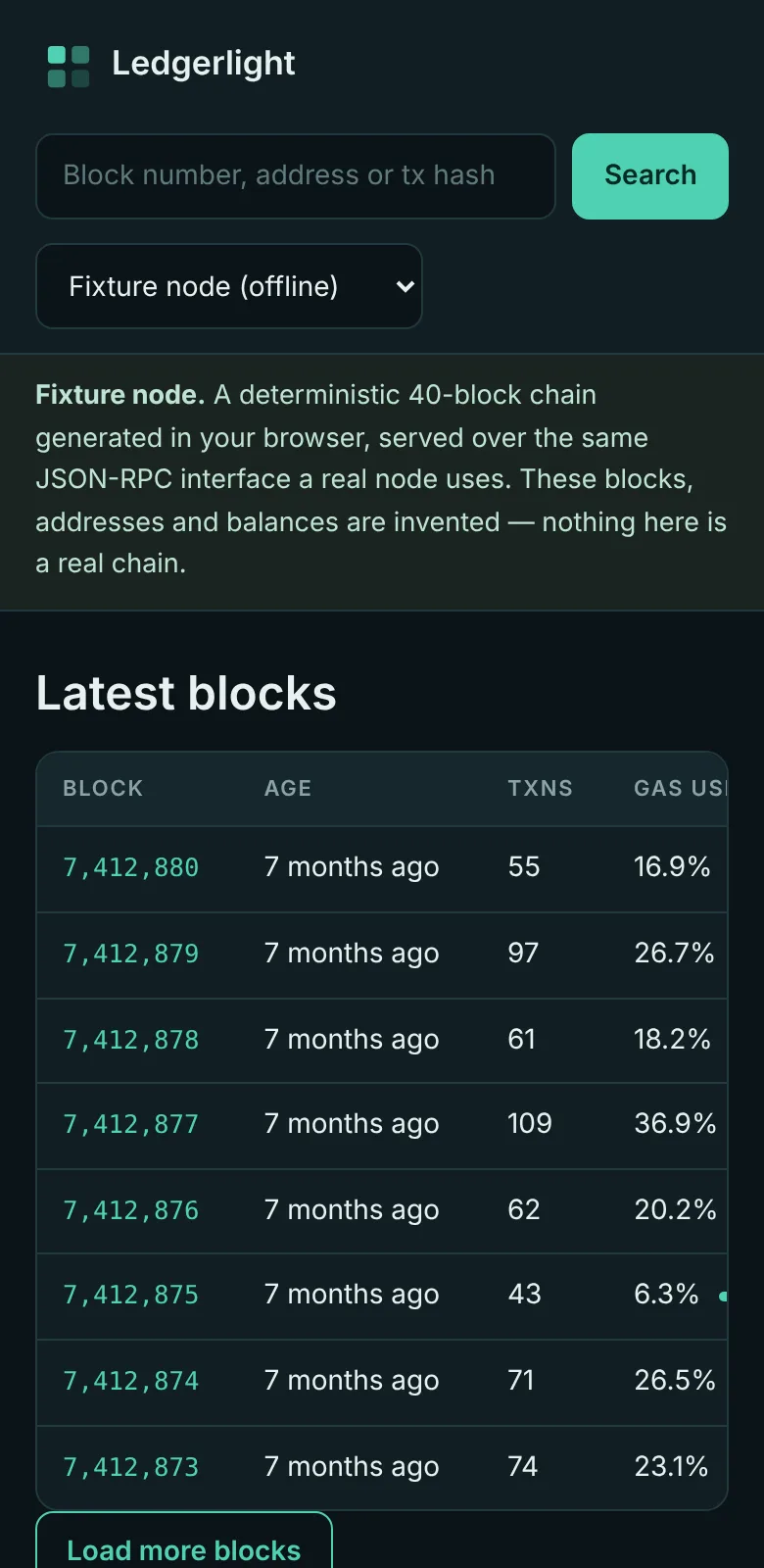
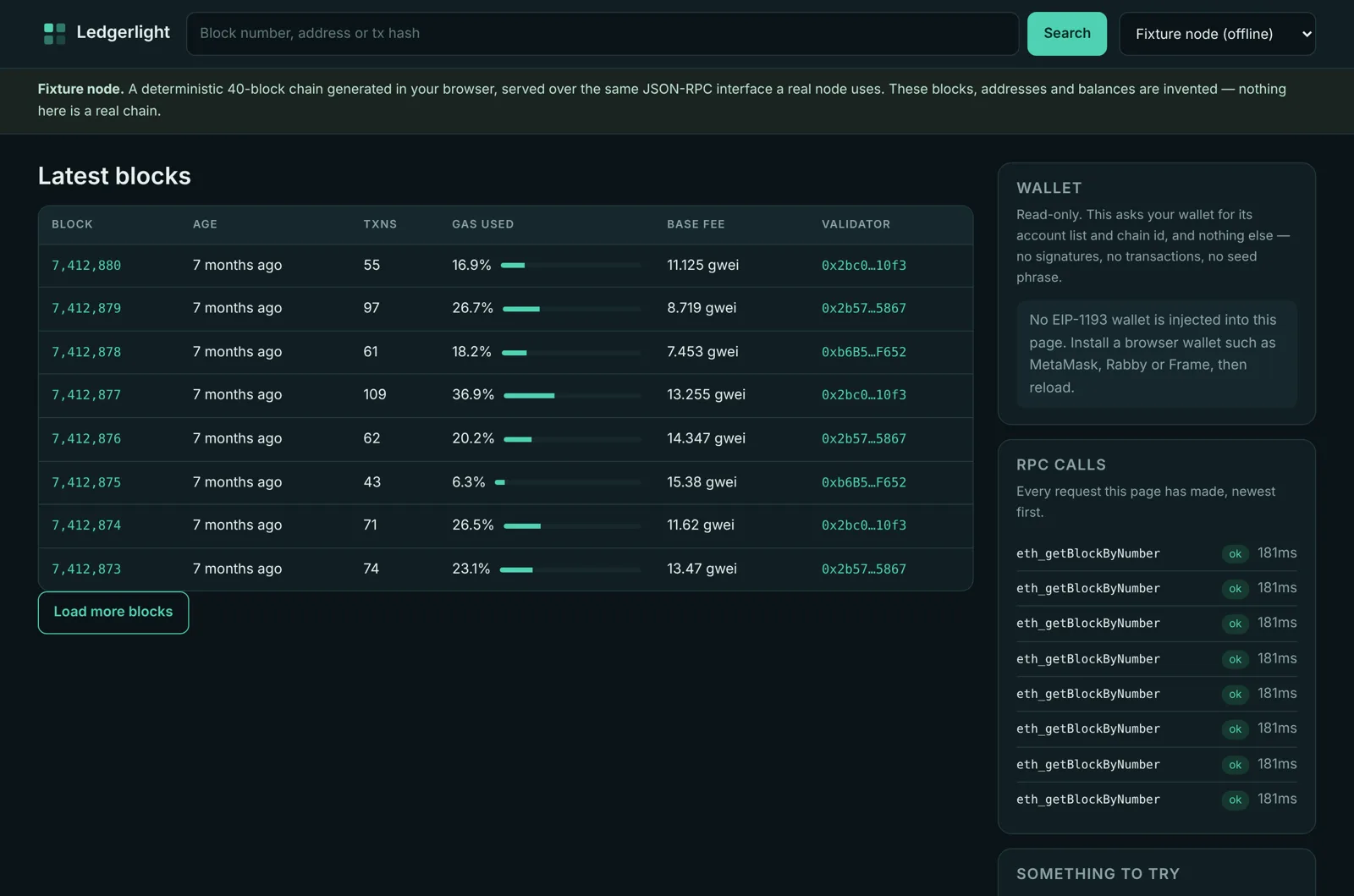
- Block list with gas usage, base fee and validator, and block, transaction and address views
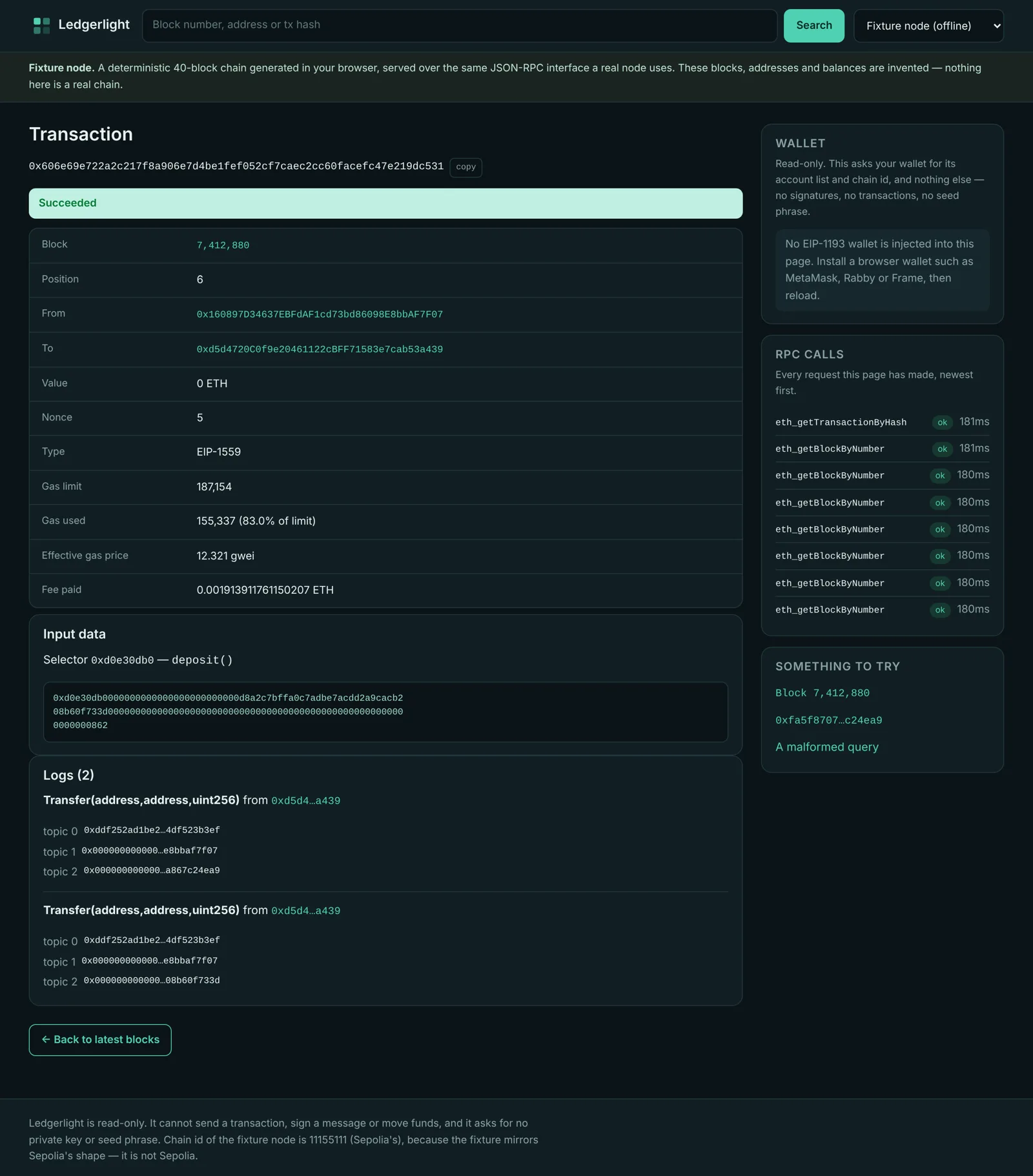
- Receipts with status, gas used and the fee actually paid
- Calldata selectors and log topics named from a local signature table
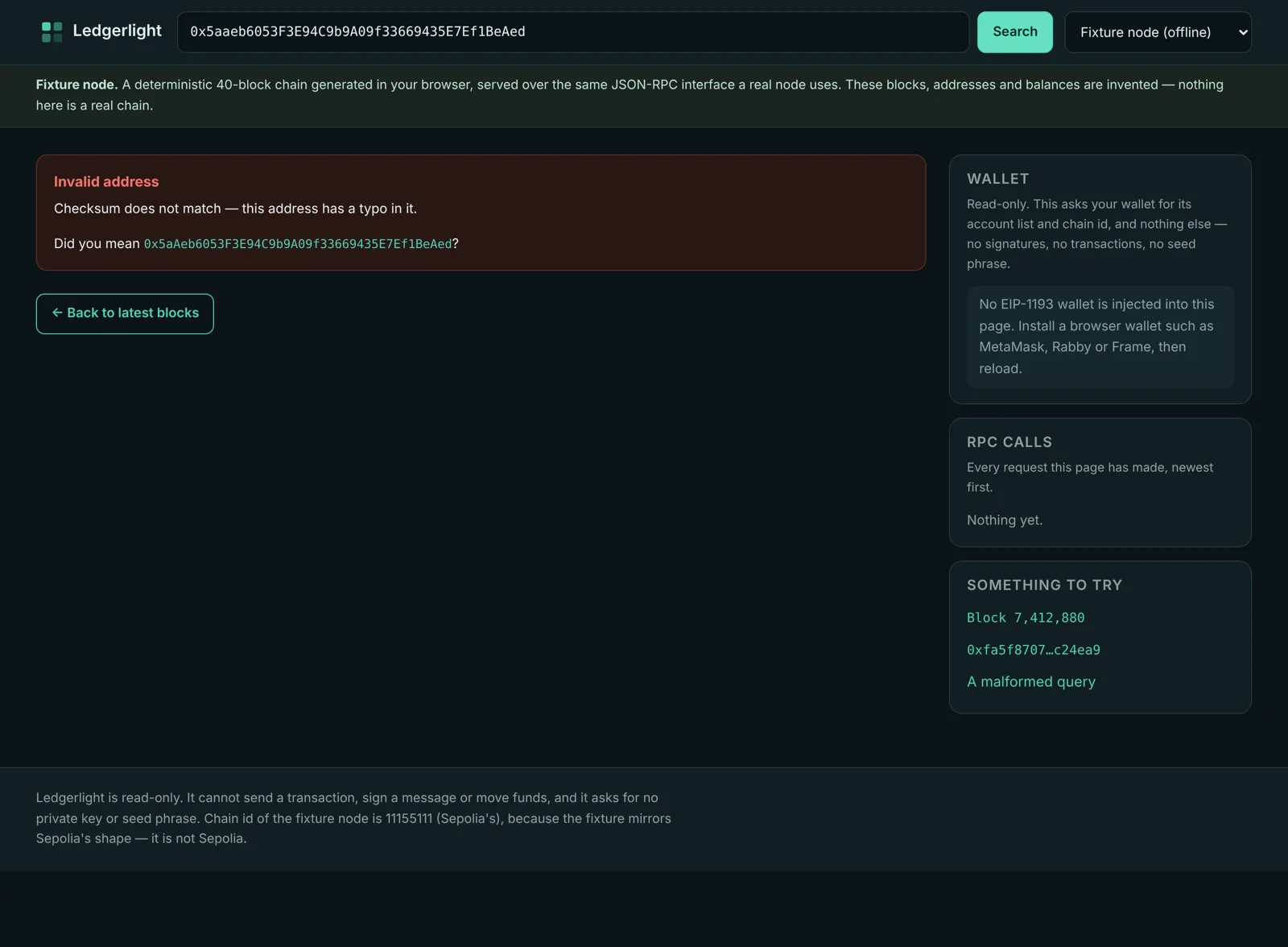
- EIP-55 validation that rejects a mixed-case address with a bad checksum and offers the correction
- Read-only EIP-1193 wallet connection with honest states when no wallet is present
- A visible log of every JSON-RPC call the page has made, with outcome and duration
Process
- Implemented Keccak-256 and verified it against the empty string, "abc", "hello" and the canonical ERC-20 Transfer topic.
- Implemented EIP-55 and verified it against the specification's four vectors.
- Wrote the RPC client with typed failures, then the fixture node that exercises each of them.
- Built the explorer: block list, block, transaction with receipt and logs, address, and a visible log of every RPC call made.
- Added the wallet panel, read-only, with the forbidden-methods test.
Engineering and creative decisions
Keccak-256, not SHA3-256
Ethereum uses the original Keccak padding (0x01), not NIST's (0x06), and the two produce completely different digests. The suite checks the published vectors and adds an explicit assertion that the output is not SHA3-256.
Every quantity is a bigint
A balance in wei overflows a JS number. Formatting truncates rather than rounds, so an explorer never shows more than the chain holds.
The fixture is a node, not a mock
It implements the JSON-RPC envelope, returns null for a missing hash and -32601 for an unknown method, and respects the AbortSignal. The client path under test is the real one.
Read-only is enforced by a test
The wallet module is asserted never to call eth_sendTransaction, eth_sign, personal_sign, eth_signTypedData_v4 or eth_sendRawTransaction. The network list contains three testnets and no mainnet.
What was delivered
An explorer that reads blocks, transactions, receipts and addresses, decodes calldata selectors and log topics, checksums every address it displays, and tells you plainly whether it is reading a fixture or a live node.
Results
- 62 unit tests and 25 browser checks pass.
- The Keccak implementation reproduces every published vector, including the ERC-20 Transfer topic 0xddf252ad… that appears in every such log on every EVM chain.
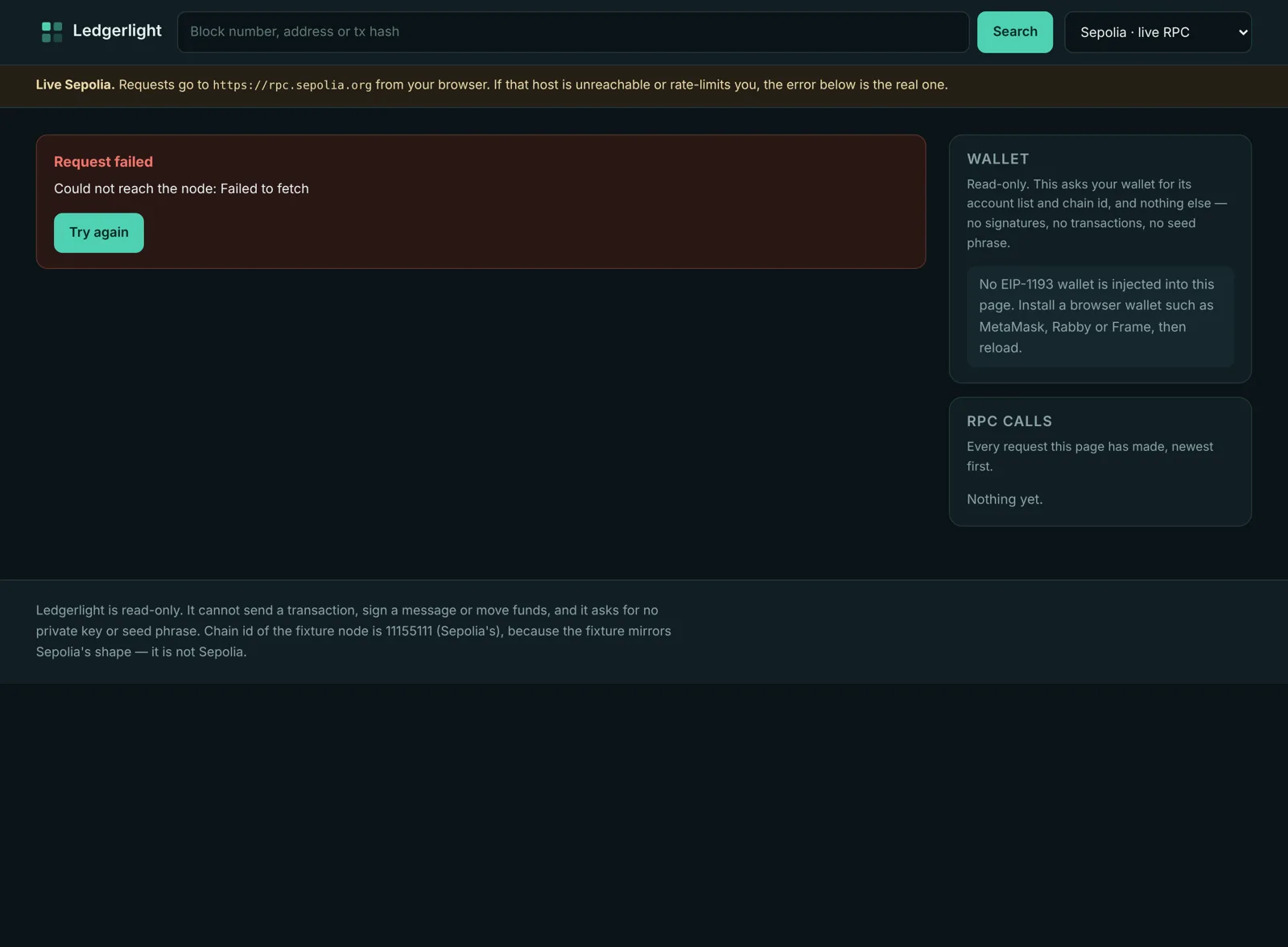
- A browser test aborts the connection to a live endpoint and asserts the real error appears with no fixture rows behind it, so the "live" mode cannot silently fall back.
- **The live-network path has never reached a real node.** The environment this was built in blocks outbound requests to public RPC endpoints. The code and its failure handling are tested; the success path against a real chain is not.
- No ethers, viem, web3.js or js-sha3: the cryptography and encoding are in the source.
These are tested capabilities of the demonstration, not commercial outcomes.
Technology stack
Visual demonstration
Captured from the running application.