Tessera Clayworks: E-Commerce Storefront
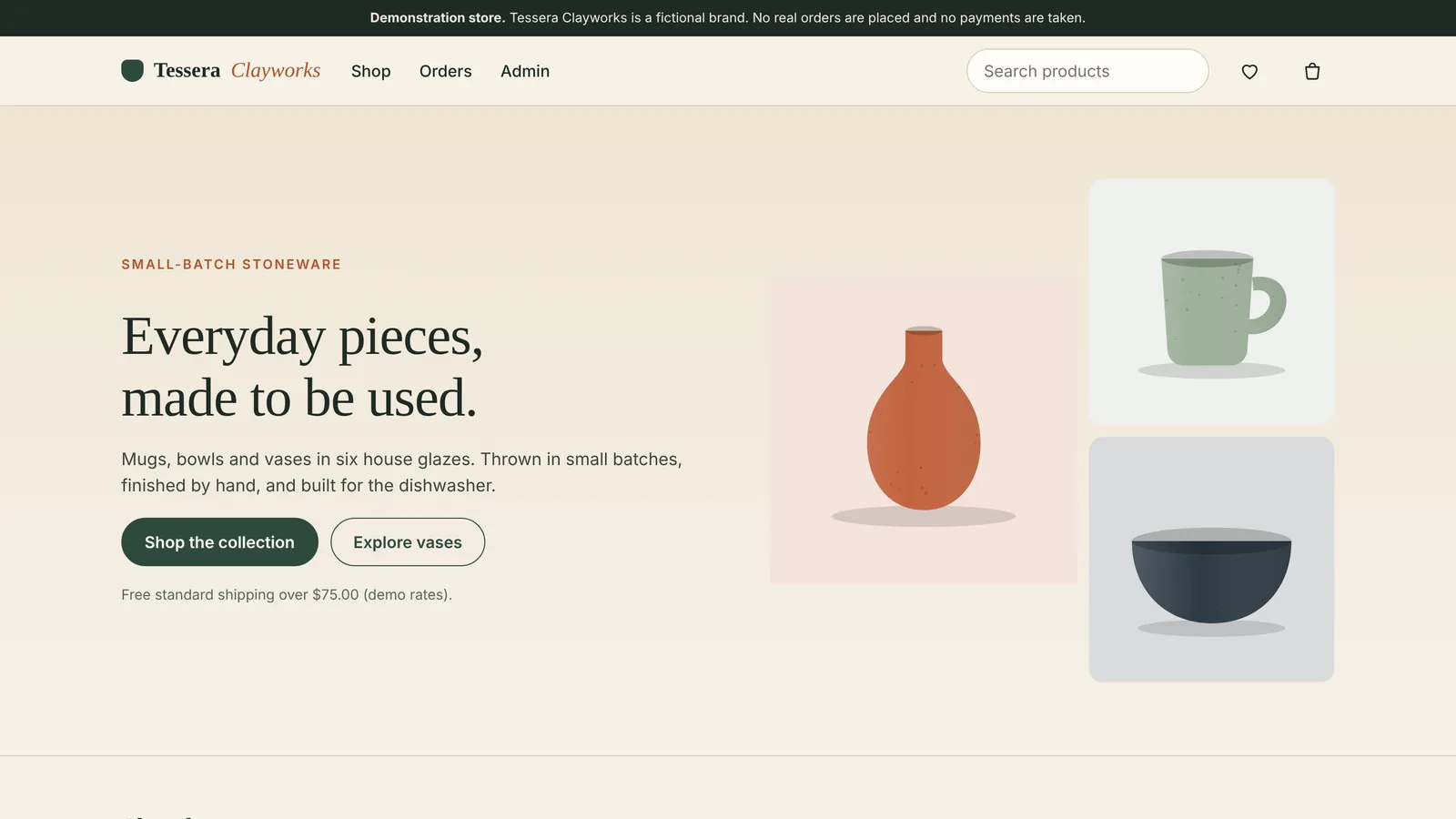
A complete demonstration storefront for a fictional ceramics studio: catalogue with working filters, product variants, cart, simulated checkout and a product admin that writes back to the shop.
This is a working demonstration, not a client engagement. The brand and data are fictional.
Background
Tessera Clayworks is a fictional small-batch ceramics studio invented for this project. The brief was to build the storefront such a business would actually need, so the work shows commerce mechanics rather than a styled template.
The challenge
Most portfolio storefronts are a grid of product photos with buttons that do nothing. The hard parts of commerce are the ones that are usually faked: filters that really narrow a catalogue, variants that change price and availability, a cart that cannot oversell, and totals that stay correct when a discount pushes an order back below the free-shipping threshold.
Objectives
- Build the commerce mechanics that portfolio storefronts usually fake: real filtering, real variants, a cart that cannot oversell.
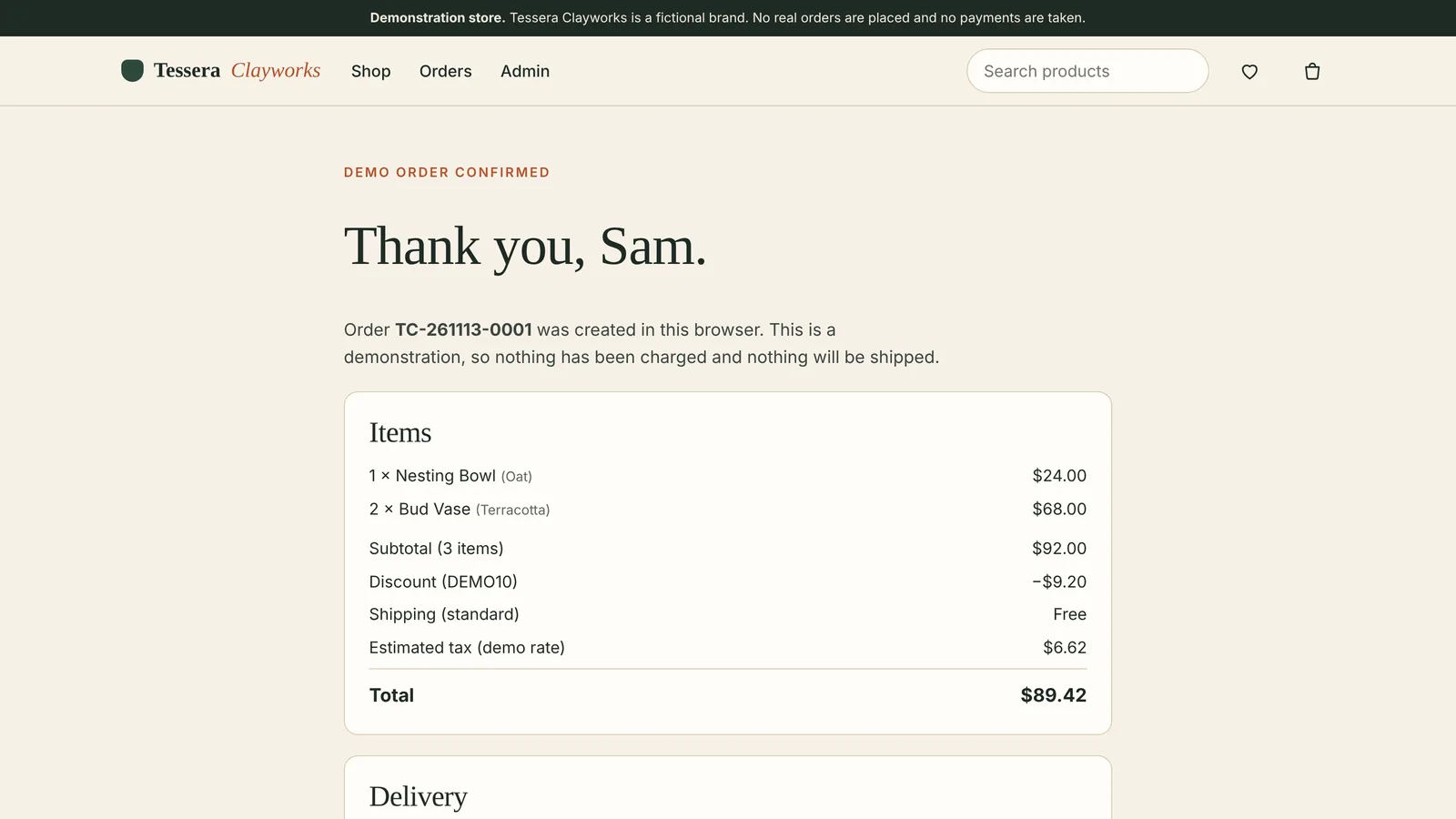
- Keep pricing, promotions, shipping and tax correct under every combination, including a discount that drops an order back below the free-shipping threshold.
- Make the catalogue genuinely editable through an admin, so the data is not a frozen fixture.
- Prove the shopping journeys work end to end rather than asserting they do.
My role
Sole designer and developer
- Designed the brand, layout and interface, separate from this portfolio's visual identity
- Built the catalogue, filtering, sorting and search
- Implemented the cart, promotions, shipping rules and tax estimate in integer cents
- Built the simulated checkout with client and server-grade validation and stock enforcement
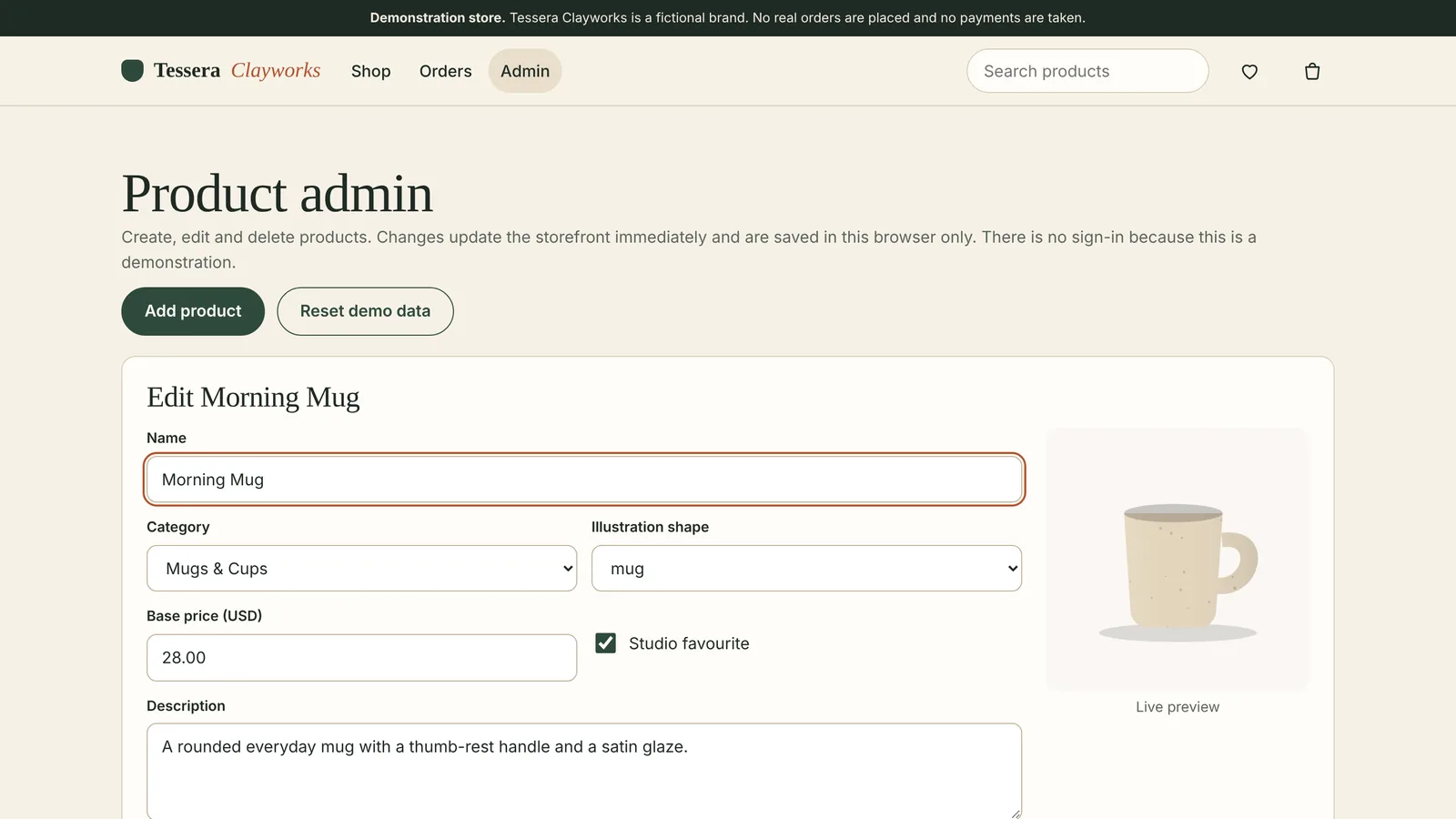
- Built the product admin with create, edit and delete, validation and live preview
- Drew every product illustration in code as SVG, with no stock photography
- Wrote 18 unit tests and a 38-check browser suite covering the shopping journeys
Technical approach
I separated the commerce rules from the interface. Pricing, cart, promotions, shipping, tax and checkout live in plain TypeScript modules with no React imports, so they can be unit tested directly and reused by a real backend later. Every amount is held in integer cents, so no total is subject to floating-point drift. The interface is a thin layer over those rules.
What is implemented
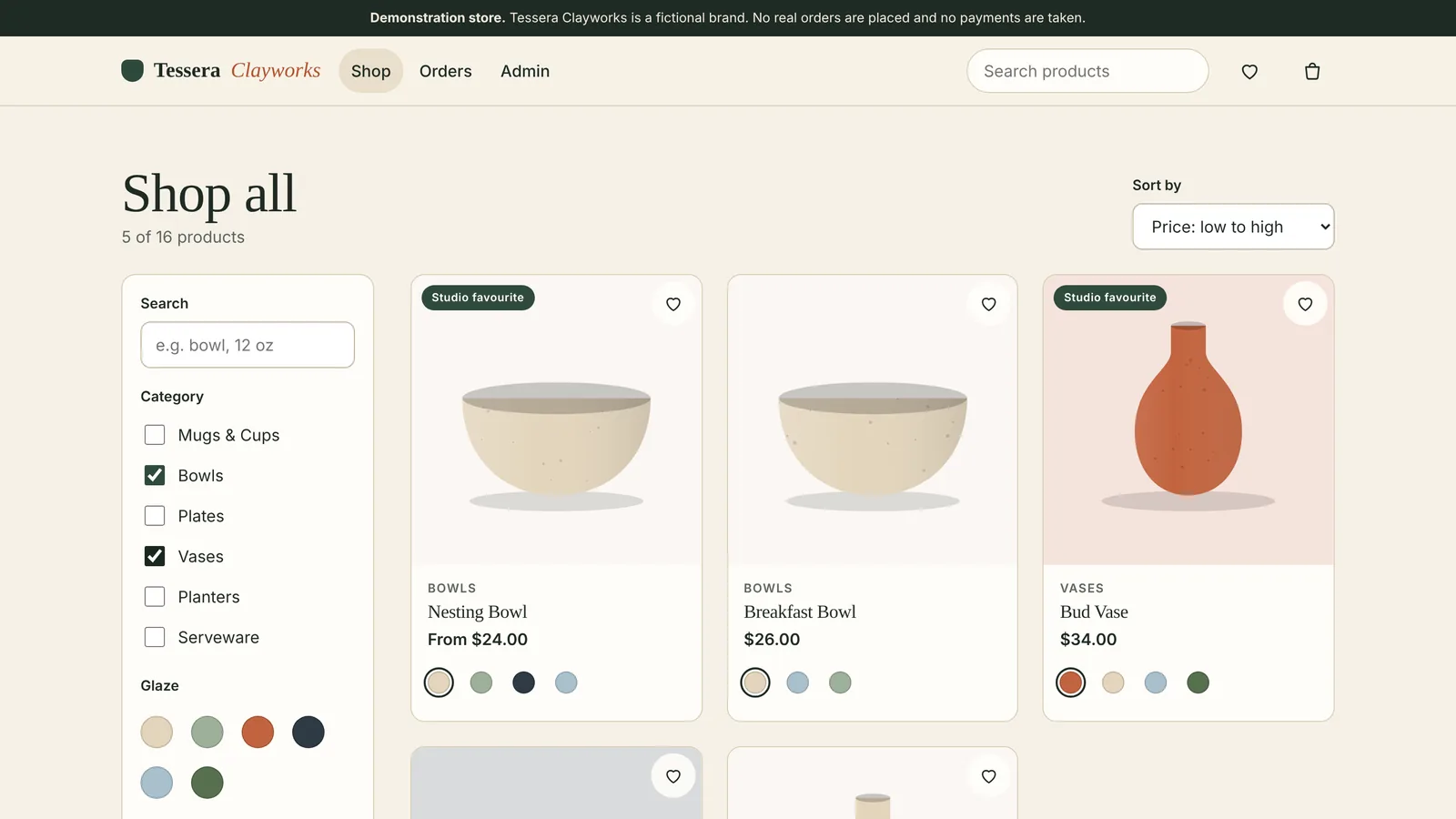
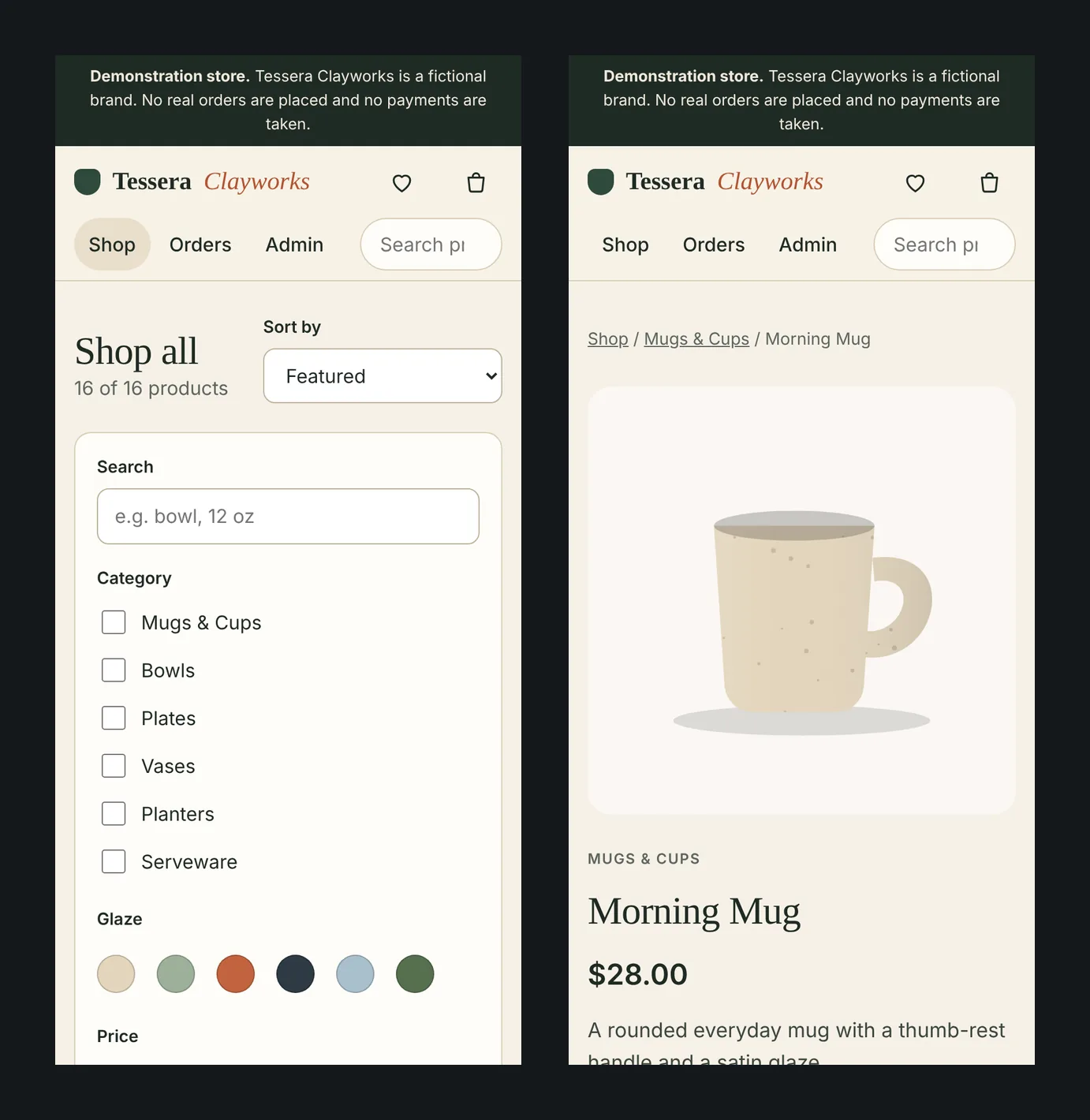
- Catalogue with category, glaze and price filters, search and sorting
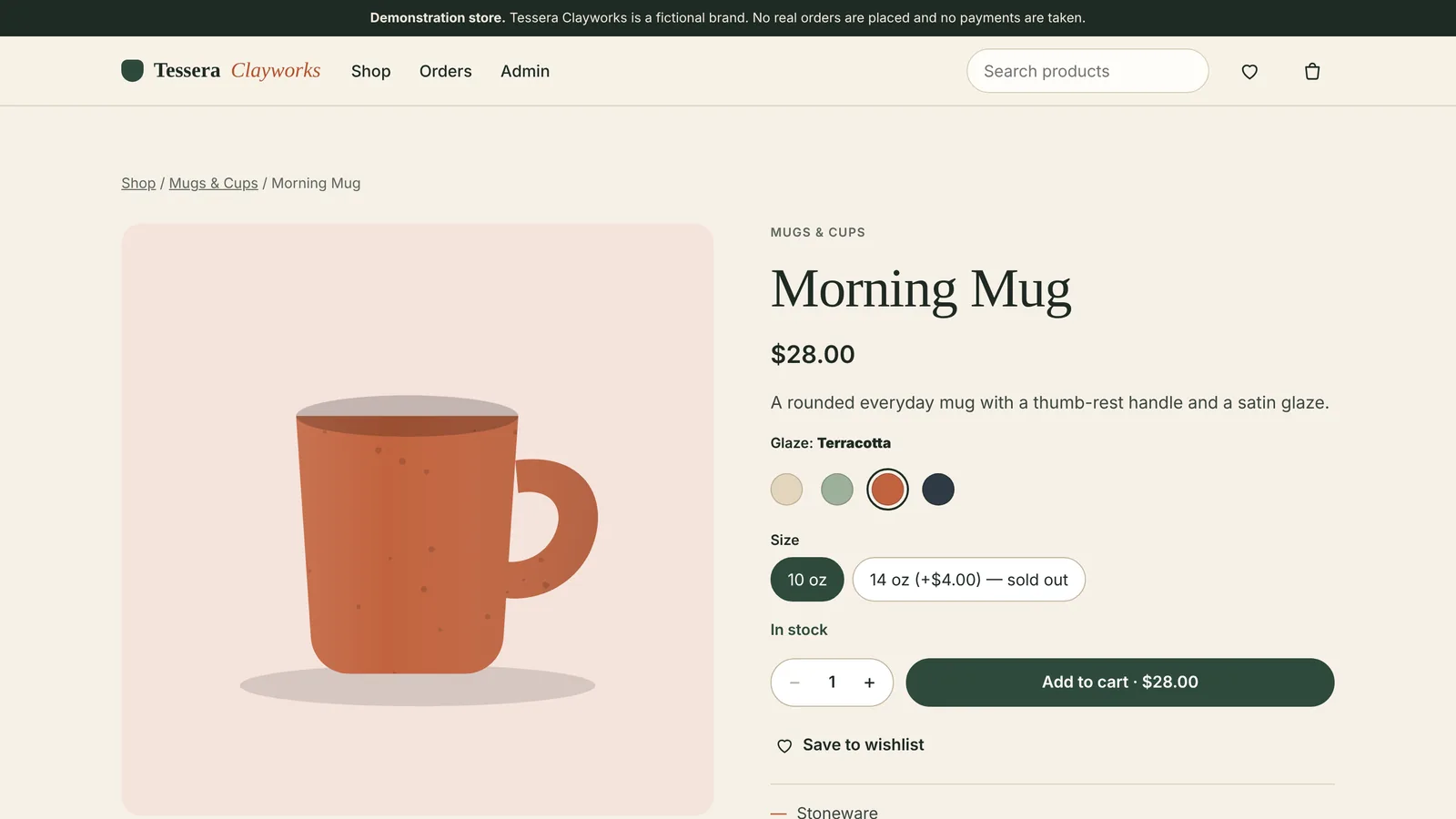
- Product pages with glaze and size variants that change price, stock and the illustration
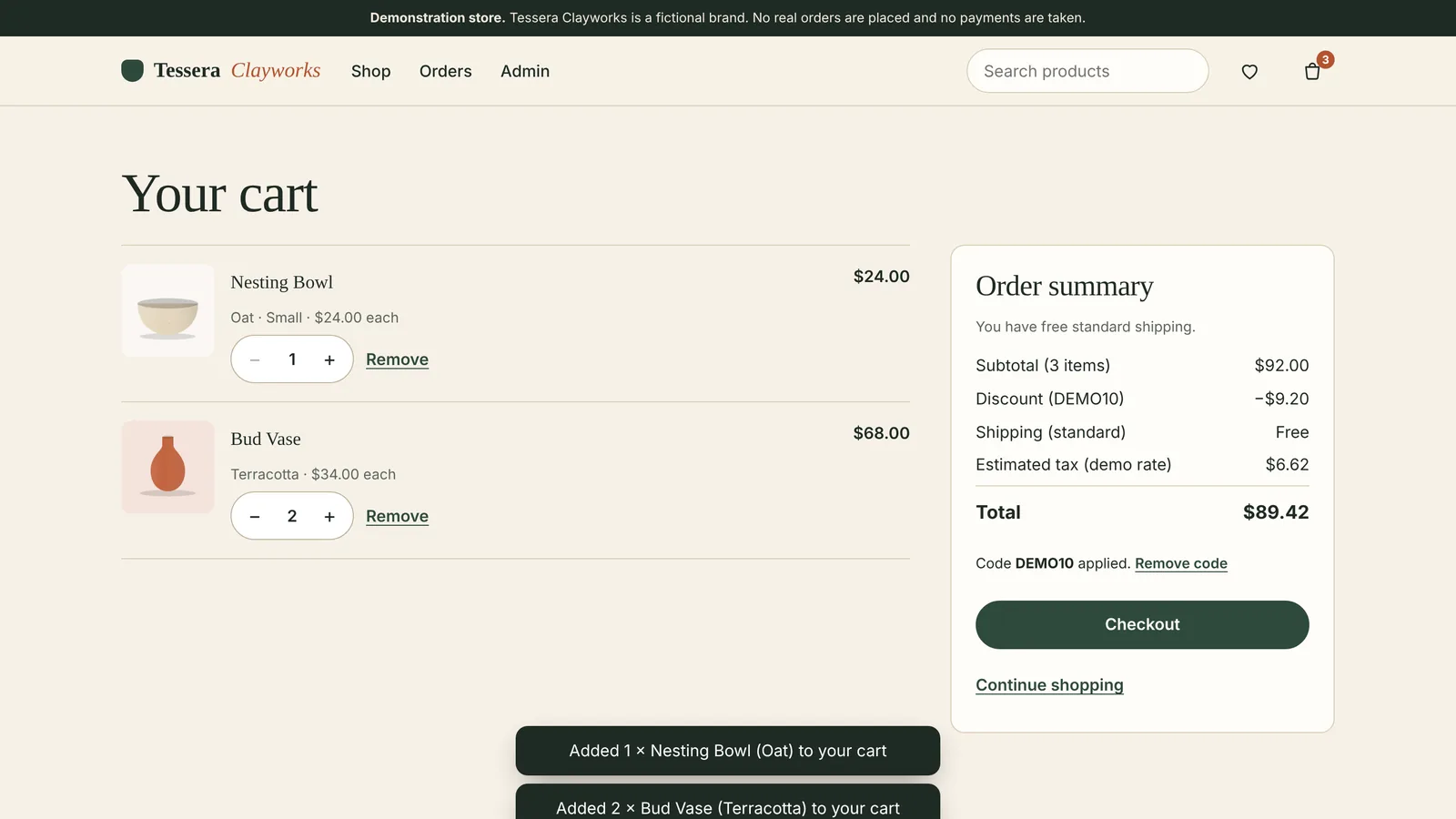
- Cart with quantity steppers, stock caps, promotion codes and a live order summary
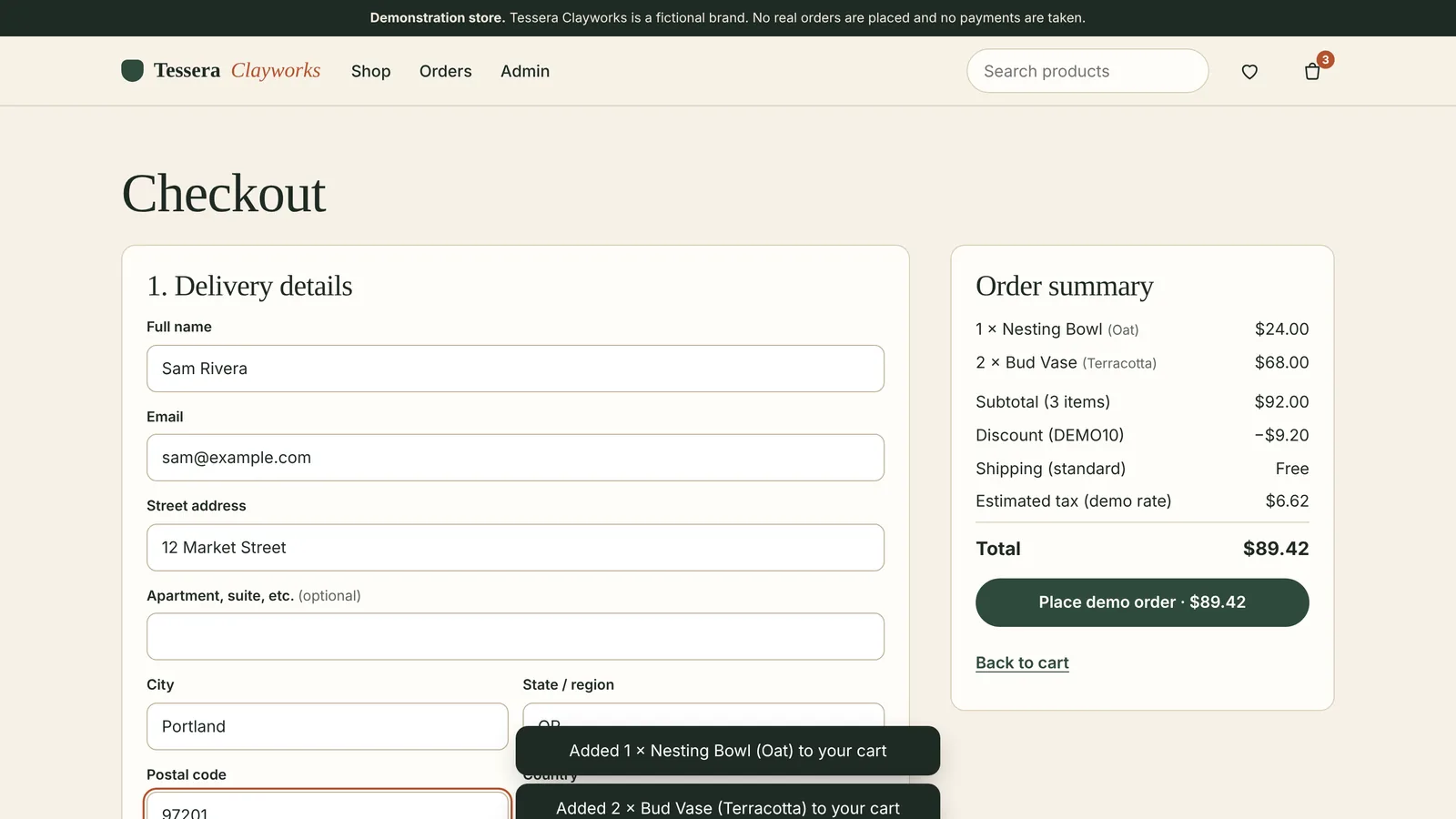
- Three-step checkout with field-level validation, shipping options and a simulated payment
- Product admin with create, edit, delete, validation, confirm-before-delete and live preview
- Wishlist, order confirmation and an order history view
Process
- Modelled the domain: products, glaze and size variants, per-variant stock, cart lines, promotions and orders.
- Wrote the pricing and cart rules first, with 18 unit tests covering stock caps, discount interaction with the free-shipping threshold, and order creation.
- Designed a brand distinct from this portfolio, using warm paper, forest green and terracotta, so the demo reads as its own business.
- Drew all 8 product shapes as parametric SVG, tinted at runtime by the selected glaze, so changing a variant visibly changes the product.
- Built the storefront: catalogue, filters, search, sort, product pages, wishlist, cart and a three-step checkout.
- Built the product admin so the catalogue is genuinely editable, with validation, confirm-before-delete and a live preview.
- Wrote a 38-check Playwright suite covering the shopping journeys end to end, then fixed the two real defects it surfaced.
Engineering and creative decisions
Commerce rules live outside React
Pricing, cart, promotions, shipping, tax and checkout are plain TypeScript modules with no React imports. They can be unit tested directly and handed to a real backend later without rewriting them.
Every amount is an integer in cents
Money is never a float. A catalogue price, a percentage discount and a tax estimate all compose without drift, which is why the totals in the tests are exact rather than approximate.
Product art is drawn in code
All eight product shapes are parametric SVG tinted at runtime by the selected glaze, so changing a variant visibly changes the product. No stock photography, and no gap between what the data says and what you see.
Stock is enforced on the server path too
The checkout re-validates stock at submission rather than trusting the cart, so a quantity edited in another tab cannot oversell.
What was delivered
A static, deployable storefront of roughly 2,400 lines of TypeScript. Filters, cart, checkout, order history and admin all work against the same in-browser state, so an order placed in the shop reduces the stock the admin reports. Nothing is faked at the interface layer: where a real store would call a payment provider, the demo says so plainly instead of showing a false success.
Results
- 18 unit tests and 38 browser checks pass, covering catalogue, cart, checkout, admin CRUD and keyboard access.
- Verified no horizontal overflow at 360, 390, 768, 1024 and 1440 px, with interactive targets at least 40 px.
- Testing caught two genuine defects: a hidden-label rule that widened the page on mobile, and colour swatches that rendered blank. Both were fixed and are now covered by tests.
- Production bundle is 240 KB of JavaScript and 14 KB of CSS, with no UI framework, icon library or image dependencies.
These are tested capabilities of the demonstration, not commercial outcomes.
Technology stack
Visual demonstration
Captured from the running application.