Meridian: Inventory & Purchasing Operations
An inventory and purchasing system built on an append-only movement ledger: stock is never stored as a number, it is the sum of its movements. Receipts, transfers, reorder suggestions and valuation all derive from the same record.
This is a working demonstration, not a client engagement. The brand and data are fictional.
Background
Meridian is an invented distributor. The system covers the part of operations where mistakes are expensive: knowing what you have, what is coming, and what to order.
The challenge
Inventory systems that store a quantity field drift. A failed write, a double-click or a race and the number no longer matches reality, with no record of how it got there.
Objectives
- Make stock impossible to drift by never storing it as a number.
- Keep purchase orders, receipts and reorder advice consistent with the same record.
- Refuse the operations that corrupt an inventory system rather than recording them.
My role
Sole designer and developer
- Designed the ledger as the single source of truth: balances are computed, never written
- Built the posting gate that refuses movements which would drive stock negative or carry the wrong sign
- Implemented transfers as matched movement pairs, so a transfer can never create or destroy stock
- Built purchase orders with status derivation, over-receipt refusal and partial receipts
- Implemented reorder suggestions that account for stock already on order
- Wrote 31 unit tests and 27 browser checks
Technical approach
An append-only ledger. Every change is a movement with a reason, a reference and a timestamp; on-hand is the sum. Nothing can silently change a balance, and every balance can be explained by replaying its movements.
What is implemented
- Append-only movement ledger with reason, reference and timestamp on every entry
- On-hand, on-order and running balances computed from the ledger
- Transfers posted as matched pairs, so stock cannot be created or destroyed
- Purchase orders with partial receipts, status derivation and over-receipt refusal
- Reorder suggestions that account for stock already on order
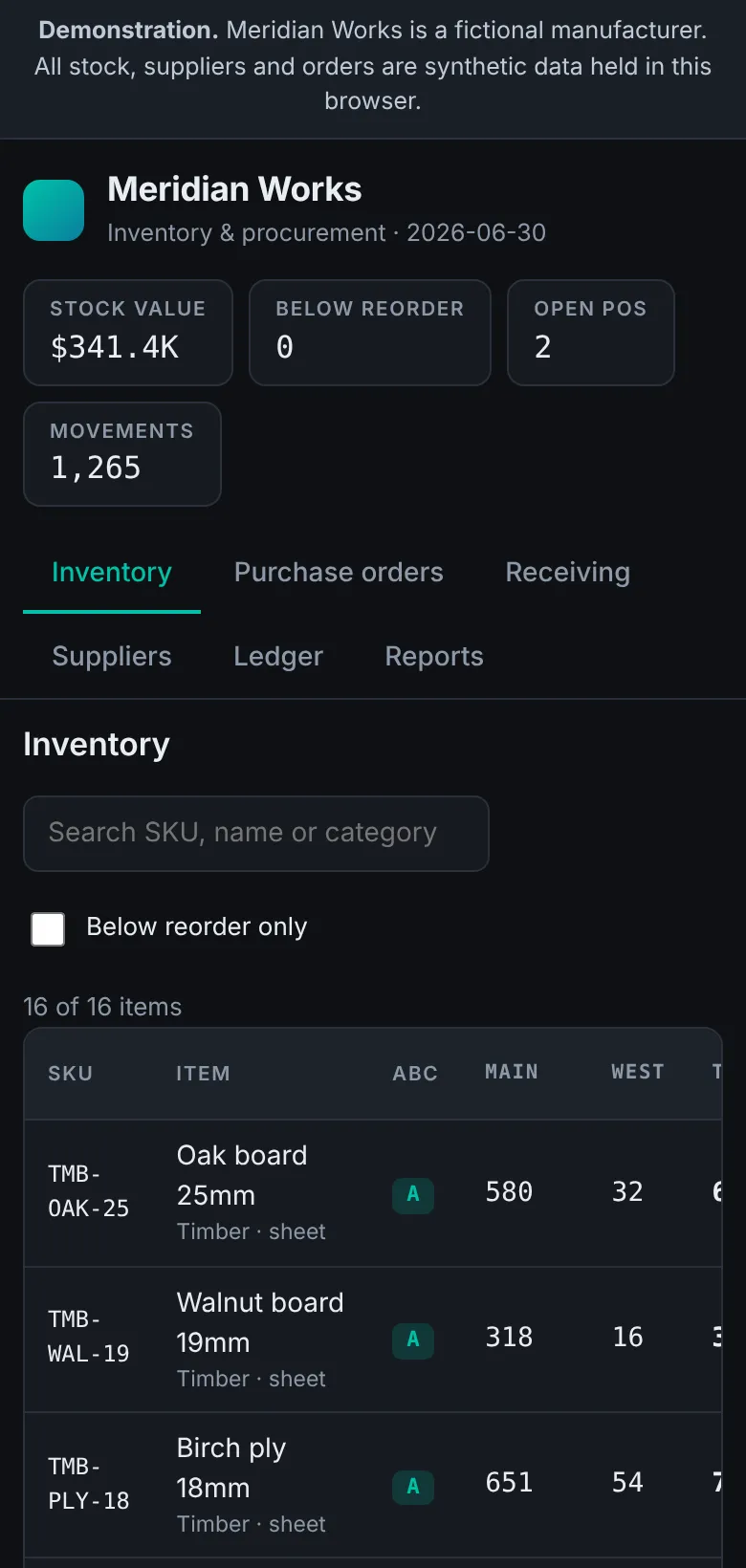
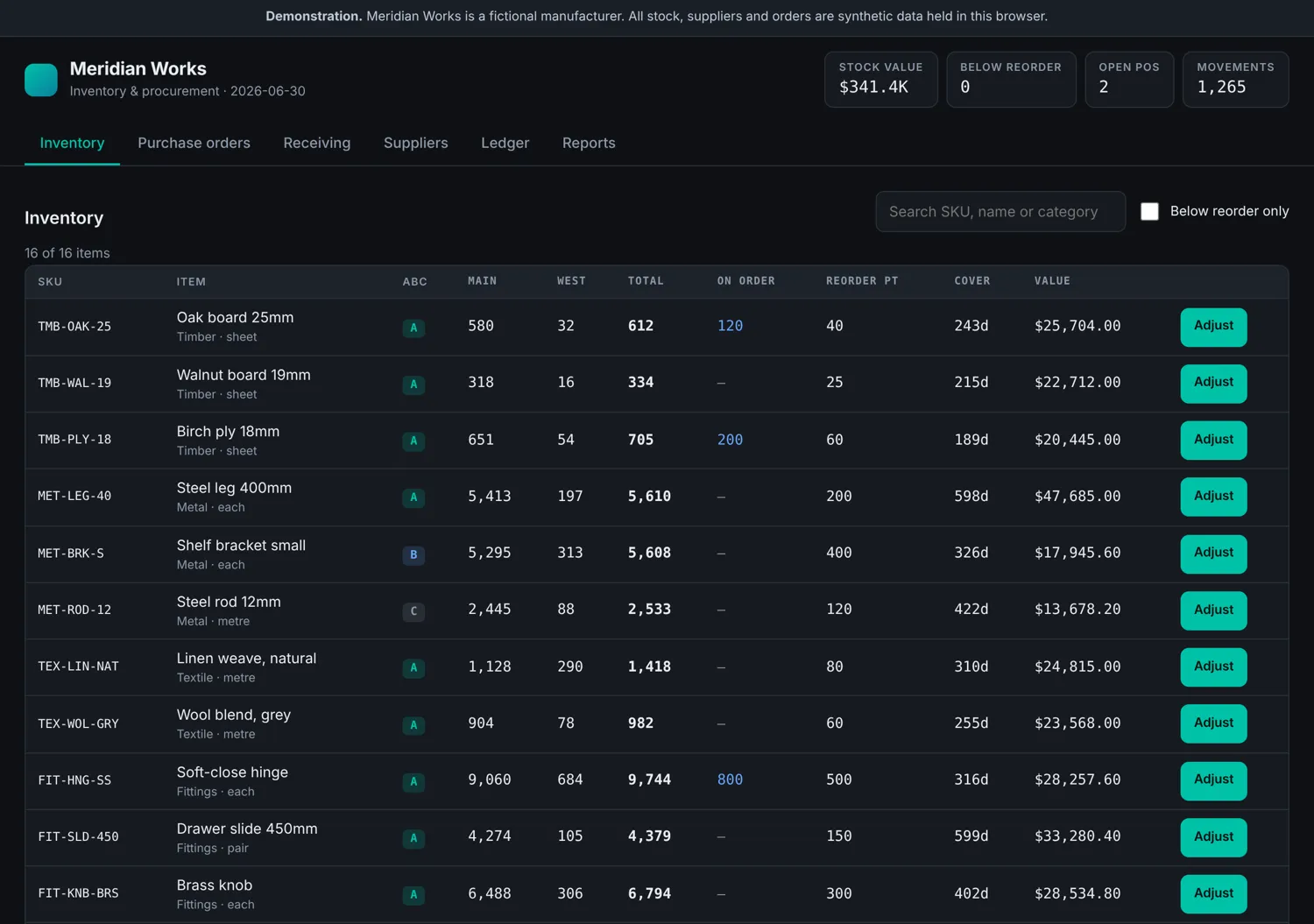
- Stock valuation and a movement history view per SKU
Process
- Built the ledger primitives (post, transfer, balances, running balance, valuation) with the posting gate refusing invalid movements.
- Built purchasing on top: orders, partial receipts, status derivation and over-receipt refusal.
- Added reorder suggestions, then found the inconsistency described below.
- Wrote the browser suite over the real interface.
Engineering and creative decisions
The ledger is the only source of truth
Balance is the sum of movements, never a stored field. Every figure can be explained by replaying its movements, and a failed write cannot leave a quantity that no longer matches reality.
The posting gate refuses invalid movements
A movement that would drive stock negative, or that carries the wrong sign for its type, is rejected at the boundary rather than written and corrected later.
Reorder advice and the stock table share a calculation
They did not at first: the headline said 'below reorder: 0' while the table flagged an item, because one counted stock on order and the other did not. Both now use the same figure and a test asserts they agree.
What was delivered
A system where the stock figure, the movement history, the purchase orders and the reorder advice are all views of one ledger, so they agree by construction.
Results
- 31 unit tests and 27 browser checks pass.
- Testing caught a contradiction the interface was showing: the headline said "below reorder: 0" while the table flagged an item. The reorder calculation counted stock on order and the table did not. Both now use the same figure, and a test asserts they agree.
- My own seed-size expectation was wrong: the fixture holds 1,265 movements, not the 1,500+ I had assumed. The test was corrected to the real number.
These are tested capabilities of the demonstration, not commercial outcomes.
Technology stack
Visual demonstration
Captured from the running application.