Lantern: Supplier Sourcing & Landed Cost
A sourcing tool that compares suppliers on landed cost rather than unit price: incoterms, duty by HS code, freight by volume or weight, and a weighted score across cost, speed, quality, reliability and responsiveness.
This is a working demonstration, not a client engagement. The brand and data are fictional.
Background
Lantern is an invented sourcing desk. The tool addresses the mistake that costs importers the most money: choosing a supplier on unit price.
The challenge
Unit price is a small part of landed cost. Freight, duty, insurance and the incoterm can reverse a ranking entirely, and the arithmetic is fiddly enough that spreadsheets get it wrong.
Objectives
- Compare suppliers on landed cost rather than unit price.
- Make the incoterm decide which cost lines the buyer actually pays.
- Score suppliers against each other rather than against an invented ideal.
My role
Sole designer and developer
- Implemented landed-cost calculation across EXW, FOB, CIF and DDP, zeroing the cost lines each incoterm already covers
- Built duty lookup by HS code and freight costing that takes the greater of volumetric and actual weight
- Designed the weighted supplier score and implemented it as relative scoring, so suppliers are ranked against each other rather than against arbitrary absolutes
- Built working-day-aware arrival estimates, shipment progress and milestone variance
- Wrote 31 unit tests and 21 browser checks
Technical approach
Model the cost lines explicitly and let the incoterm decide which ones the buyer pays. Score suppliers relatively across five weighted factors, so the comparison answers "which of these" rather than scoring against an invented ideal.
What is implemented
- Landed-cost model across EXW, FOB, CIF and DDP with per-incoterm cost allocation
- Duty lookup by HS code and freight costed on the greater of volumetric and actual weight
- Weighted supplier score across cost, speed, quality, reliability and responsiveness
- Working-day-aware arrival estimates, shipment progress and milestone variance
- Quantity and incoterm controls that visibly reorder the comparison
Process
- Built the landed-cost model with freight rates, duty by HS code and per-incoterm cost allocation.
- Implemented relative scoring with weights of 40% cost, 20% speed, 20% quality, 12% reliability and 8% responsiveness.
- Added shipment progress and milestone variance for orders already placed.
- Wrote the test suite, correcting my own wrong assumption described below.
Engineering and creative decisions
Cost lines are modelled, not approximated
Freight, duty, insurance and handling are separate lines, and the incoterm zeroes the ones the seller already covers. That is what lets changing EXW to DDP reverse a ranking.
Relative scoring
Suppliers are scored against each other, so the comparison answers 'which of these' rather than grading everyone against an absolute that nobody set.
Integer-cent arithmetic throughout
The same rule as the storefront: money never touches a float, so a landed cost built from six lines across two currencies stays exact.
What was delivered
A comparison where changing quantity or incoterm visibly reorders the suppliers, because the full cost is recomputed rather than the unit price being decorated.
Results
- 31 unit tests and 21 browser checks pass.
- One of my test expectations assumed the cheapest unit price would not also be the cheapest landed; in this dataset it is. The test was rewritten to assert what is actually true: it still loses on the weighted score.
- A long select option stretched the layout to 448px inside a 360px viewport; found by the layout sweep and fixed.
These are tested capabilities of the demonstration, not commercial outcomes.
Technology stack
Visual demonstration
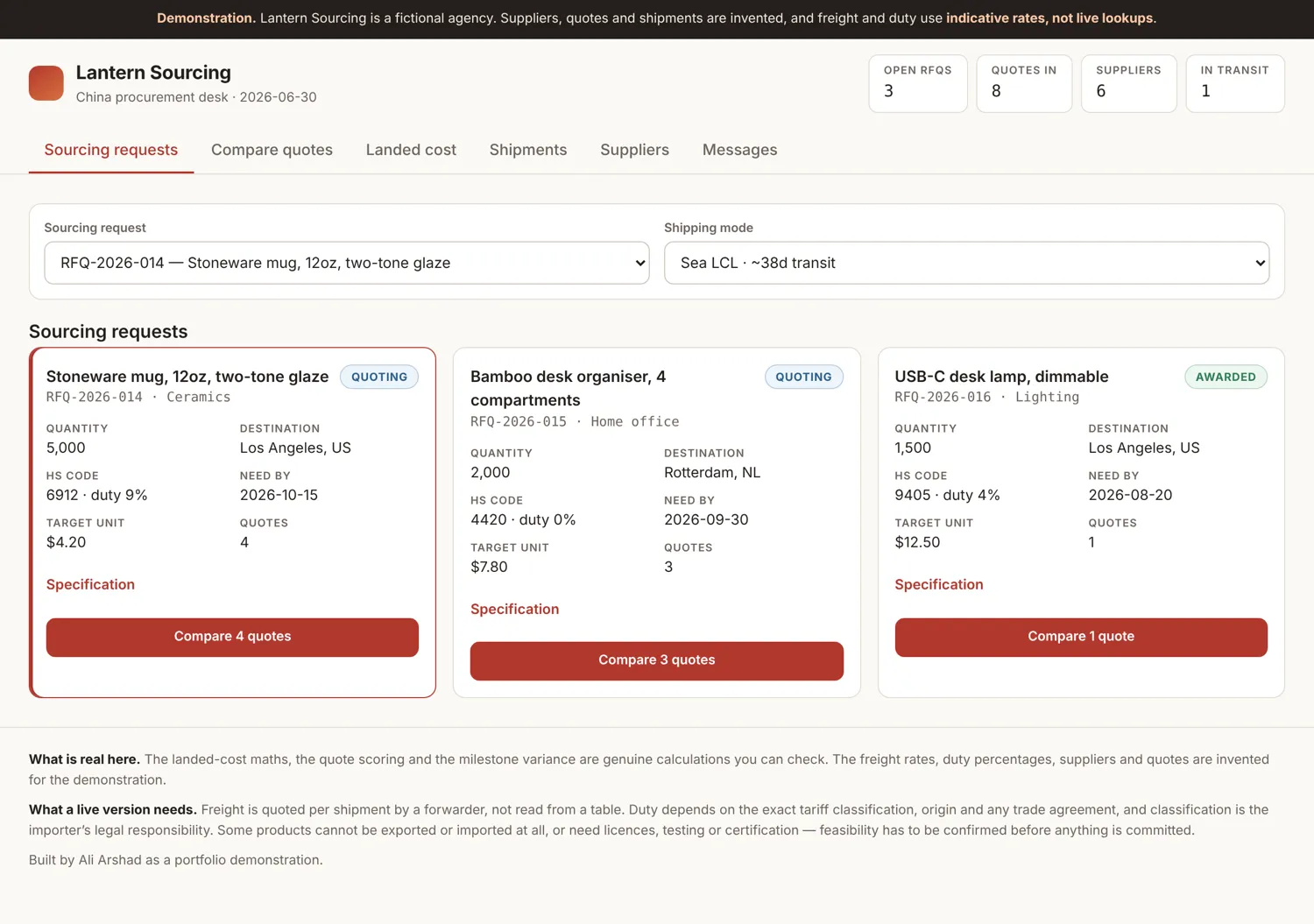
Captured from the running application.